
Rice County Court Records After Arrest
After a Rice County arrest, the jail roster is only the custody side of the event. The court record starts when the Rice County Attorney files or pursues charges in District Court. The official County Attorney page says that office acts as the main law-enforcement officer for the State of Kansas in criminal cases and handles felony cases plus misdemeanor and traffic prosecutions that are outside municipal-court jurisdiction. The case then belongs to the court file, not the jail roster.
That distinction matters. A booking row may list an arrest charge, but the prosecutor may file fewer charges, add counts, amend the wording, reduce the level, or dismiss a count later. For custody status and booking details, use Rice County jail inmate records. For booking photos, use the Rice County jail mugshots page. For filed charges, hearings, dispositions, and case status, use the court route.
Rice County is part of the Twentieth Judicial District. The District Court page identifies judges serving the district and lists court services for Barton, Ellsworth, Rice, Russell, and Stafford counties. That district context matters because bond supervision, diversion, probation-related issues, and court services may not be handled by the same office that runs the jail roster.
Find Rice County Court Records After Arrest
Rice County District Court links to the official Kansas Case Search portal. The Kansas Judicial Branch explains that district-court public records are moving into a centralized case-management system and online portal. Automated field inspection of the current portal was blocked, so the safest public wording is to use the live browser prompts and search by the fields the portal provides, usually party name and case number when available.
- Use the jail roster first if the person was recently booked and the court filing may not be indexed yet.
- Open Kansas Case Search and look for the defendant name or known case number.
- Review the case caption, charge list, case type, hearing entries, and current status shown by the court portal.
- If the online record is missing or unclear, call Rice County District Court at 620-257-2383 or use the courthouse public-record request process.
The Rice County District Court is located at 101 West Commercial, Third Floor, Lyons, KS 67554. Its public request phone is 620-257-2383, and the court fax is 620-257-3826. The court office hours in the research are Monday through Friday, 8:00 am to 5:00 pm.
The Rice County District Court page shows the courthouse contact details and links to court public access. That official page is the local source to check before relying on an online case result alone.
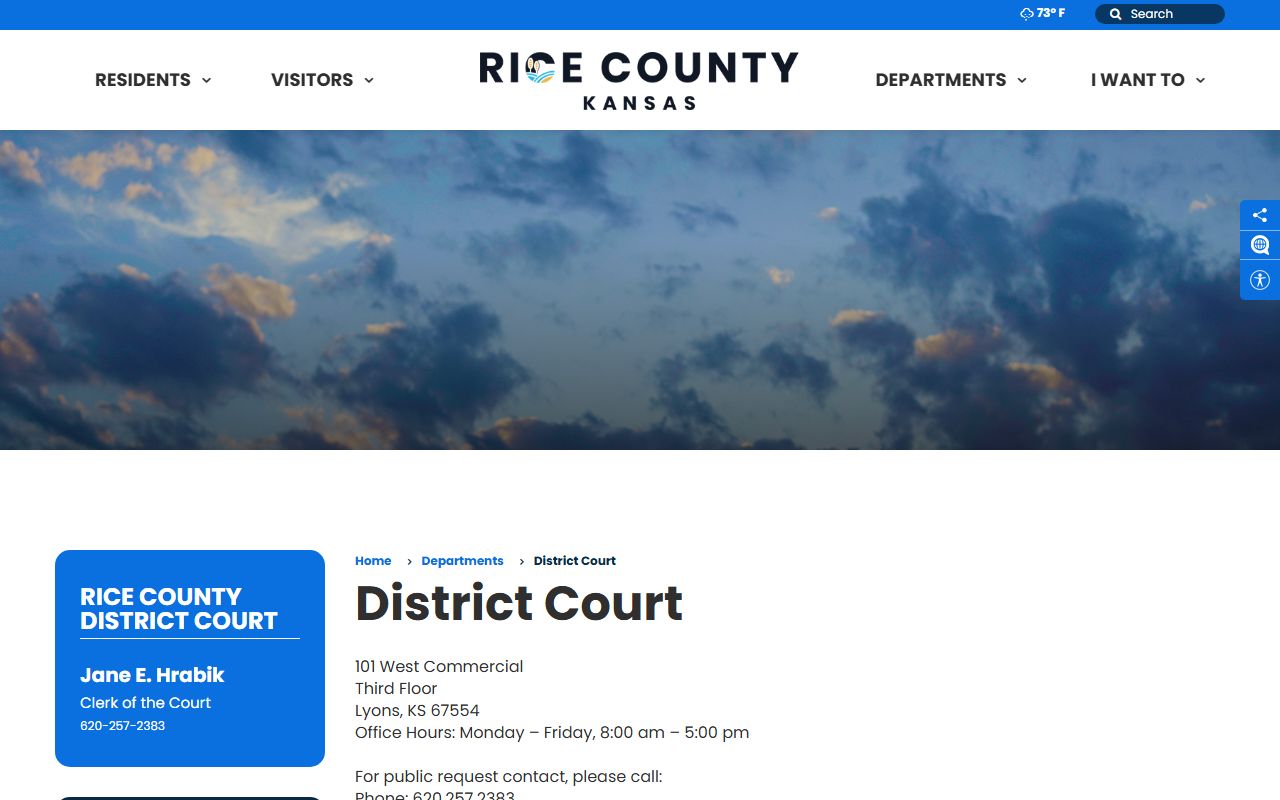
The court screenshot supports the key routing point: court records after a Rice County jail arrest are handled through the courthouse, not through the detention phone alone.
Rice County Case Search Fields
The available court search fields can change because Kansas uses a live statewide portal. The research captured the official court route but did not capture a full portal field inventory due to Cloudflare blocking command-line inspection. Avoid guessing at hidden filters, fees, or account rules.
| Field Label | Type | Required | Notes |
|---|---|---|---|
| Kansas Case Search fields | Web portal | Unspecified | Use the live browser prompts from the official portal linked by Rice County District Court. |
Charges Filed After Rice County Arrest
Once the arrest and booking step is complete, the charging document controls the court case. Kansas county criminal cases may involve a complaint, information, or indictment. In ordinary county cases, the County Attorney's filing decision is the key step. It turns arrest facts into a formal court accusation that can be amended, reduced, dismissed, or resolved by plea, trial, diversion, or other disposition.
| Document | Who Uses It | What It Does |
|---|---|---|
| Complaint | Often prosecutor or officer supported filing | Starts many criminal cases and states the alleged offense. |
| Information | Prosecutor | Formal prosecutor-filed charging document, common in felony practice. |
| Indictment | Grand jury | Grand-jury charging document, less common in routine county cases. |
Rice County Charge Status
A court record after a jail arrest is not static. A charge may begin as pending, then change after review, plea talks, preliminary hearing, diversion, dismissal, or sentencing. The roster line should be treated as early custody information until the filed case is checked through court records.
| Status | What It Means |
|---|---|
| Pending | The charge or case has not reached final disposition. |
| Amended | The charge wording or count changed after filing. |
| Reduced | The charge level was lowered by plea, amendment, or court action. |
| Dismissed | The charge ended without conviction on that count. |
| Conviction | A guilty plea, verdict, or finding was entered. It is not the same as an arrest. |
Bond After Rice County Arrest
Bond may appear in jail, court, or warrant conversations, but the public roster inspected for Rice County did not show a bond field. The official inmate information page does publish an approved bonding-company list for the 20th Judicial District. Before paying a bondsman, confirm whether bond is set, whether another hold exists, and where bond may be posted.
| Bond Type | How It Works |
|---|---|
| Cash bond | Money is posted directly with the court or jail as allowed for the case. |
| Surety bond | An approved bonding company posts the bond under its fee and collateral terms. |
| PR or own recognizance | The person signs a promise to appear and follows release conditions without posting full cash bail. |
| No-bond hold | A warrant, probation or parole issue, federal hold, ICE hold, or other order may block release. |
K.S.A. 19-1930 is relevant where a person is held for another authority. It allows county jails to keep prisoners committed by U.S., city, and listed state authority under defined conditions. A hold can keep a person in custody even when a new local charge has a bond amount.
Warrants Before Rice County Arrest
No official Rice County Sheriff active-warrant search page was located. That means a reader should not treat the jail roster as a complete warrant database. A person may appear on the roster after a warrant arrest, but the absence of a name on the jail list does not prove there is no active warrant. Warrants may come from District Court, municipal court, another county, state supervision, federal court, or another agency.
For Rice County warrant questions, the research supports three local channels: sheriff non-emergency communications at 620-257-2363, Sheriff's Office Admin/Records at 620-257-7876 Option #2, and Rice County District Court at 620-257-2383 for court matters. The Kansas Attorney General's KORA FAQ also notes that warrant affidavits and sworn testimony have special access rules and are not handled like ordinary open-records requests.
Charges vs Convictions
Arrest, charge, and conviction are separate events. A Rice County arrest means a person was taken into custody or booked. A charge means the prosecutor or court filing alleges a violation. A conviction requires a plea, verdict, or finding. Public court records after an arrest should be read with that timeline in mind.
| Charge | Conviction | |
|---|---|---|
| Stage | Formal accusation in the court case | Final finding, plea, or verdict on the offense |
| Proof | Based on filing standards and probable cause | Requires plea or proof beyond a reasonable doubt |
| Record Use | May change or be dismissed | May affect sentence, supervision, and later record access |
Sealed and Expunged Arrest Records
Kansas uses expungement statutes for qualifying arrests, convictions, and diversions. K.S.A. 22-2410 covers expungement petitions for qualifying arrest records. K.S.A. 21-6614 covers expungement of certain convictions, arrest records, and diversion agreements after statutory criteria are met. Eligibility is fact-specific, so a court record that looks public today may later become restricted.
| Sealed or Restricted | Expunged | |
|---|---|---|
| Public View | Hidden from general public access under a rule, order, or statute. | Restricted after an expungement order for qualifying records. |
| Agency Access | Some courts or agencies may still have lawful access. | Some legal uses may still allow limited access under Kansas law. |
| How It Happens | By law, court rule, or order in a specific case. | By petition or process under the applicable Kansas expungement statute. |
Criminal History Search Limits
KDOC warns that KASPER is not a complete criminal-history search. For a complete Kansas criminal history, KDOC points users to the Kansas Bureau of Investigation Criminal History Record Search. Court records, jail rosters, and corrections locators each cover a different slice of information, so none of them should be treated as a full background check.
Important: Do not use casual jail or court lookups for employment, tenant, credit, insurance, or other FCRA-covered screening decisions.
Restricted Court Records After Arrest
Kansas law leaves room for records to be closed, restricted, redacted, or delayed. Juvenile matters, sealed cases, certain affidavits, criminal investigation records, expunged material, and sensitive information may not be visible in a public search. The Kansas Attorney General KORA FAQ explains that jail rosters and police blotters are generally open, while mugshots and standard arrest reports may be discretionarily closed under K.S.A. 45-221.
When a Rice County court record after a jail arrest cannot be found online, the next step is not to rely on an unofficial database. Contact District Court for the case record, the sheriff's office for the jail or booking record, and an attorney for legal advice about pending charges, warrants, bond, or expungement.